
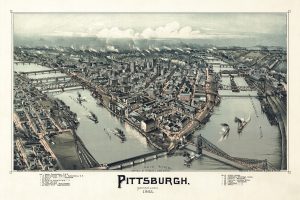
One of the most interesting things about Pittsburgh is its unique blend of old and new. The city was founded in the late 1750s, during a major battleground conflict between the British and the French. After a decisive British victory in 1758, General John Forbes named the settlement “Pittsburgh” in honor of British statesman William Pitt the Elder. Had the French won that day, we might be calling our city by a completely different—likely French—name!
Long before that, Native Americans lived in this region for centuries and gave it the Seneca name Jaödeogë. From Jaödeogë, to a city named after a statesman, to the thriving hub it is today, Pittsburgh’s story is rich—and its architecture tells that tale.
While we’re all familiar with modern construction (and have certainly contributed our fair share!), there’s something undeniably charming about the city’s historic buildings. We all know icons like the Cathedral of Learning and the Carnegie Museums—but what about the historical gems Lobos itself has to offer?
THE CINDERELLA
If you’ve driven through Lawrenceville, you’ve likely noticed our Cinderella building. This distinctive light-gray structure features a striking red door with the name “CINDERELLA” prominently displayed above it — and just above that, the year 1903.
So what was happening in Pittsburgh in 1903? Sports fans might remember the inaugural World Series, where the Pittsburgh Pirates faced the Boston Americans. Despite pitcher Sam Leever’s shoulder injury, Deacon Philippe carried the team through as we emerged champions of the National League.
At the same time, Pittsburgh was growing — rapidly. Industry was booming, and with that growth came new architectural innovation. The Cinderella building was born out of that era of expansion and ingenuity. Designed by Frederick Scheibler — a Pittsburgh architect celebrated for using cement as exterior masonry to promote a modern, eye-catching style — the Cinderella became an important addition to his portfolio.
Scheibler shared many artistic parallels with the renowned Frank Lloyd Wright, though he promoted himself far less. His history is mostly known to local Pittsburgh history buffs, as opposed to Wright’s international fame. Born in Oakland in the 1870s, he was the grandson of German immigrants who worked in the book-binding trade — humble roots for someone who went on to shape Pittsburgh’s architectural character.
Of course, there’s a more dramatic version of the Cinderella’s origin told in local folklore: a bricklayers’ strike forced builders to use cement and ash over a wood frame. While entertaining, that tale isn’t true — but the reality is just as significant. Scheibler’s vision and craftsmanship gave us one of the most historically notable apartment buildings in our portfolio.
Thanks to him, the Cinderella is not just another structure — it’s a lasting piece of Pittsburgh’s architectural story.
THE BACCHUS HOUSE
You may have been waiting for this one — we certainly know this building’s reputation. Eye-catching and often labeled an architectural oddity, the Bacchus House is officially known in our system simply as 1036 South Braddock. Its most recognizable feature is the carved face of Bacchus, the Greek god of wine — known to Roman history fans as Dionysus — proudly displayed on the facade.
The Bacchus House has lived quite a wild life, especially throughout the 1920s, when it became intertwined with some of Pittsburgh’s rougher, more mischievous history. During the ‘20s and ‘30s, Pittsburgh was a dramatically different city — a powerhouse of steel production that was hit hard by the Great Depression. Even in those challenging years, Bacchus House and the surrounding area kept their spirits high — quite literally. Braddock Avenue was booming with speakeasies and bootlegging during Prohibition, and 1036 South Braddock stood at the heart of that energy. Though the vibe has mellowed considerably since, this building has seen more than its fair share of unforgettable nights and notorious characters.
Of course, the history of Braddock Avenue itself stretches back even further — long before Bacchus took up residence. The roadway first appeared on maps in 1851 as Park Avenue, was renamed Park Street in 1881, and finally became Braddock Avenue in 1888 — the name it’s proudly carried for well over a century. The area later became a major steel hub thanks to the Edgar Thomson Steel Works, which shaped the surrounding neighborhoods and economy.
When the Depression hit, the area struggled, and buildings like 1036 South Braddock became gathering spots for Pittsburghers eager to defy the nationwide ban on alcohol — and everything that came with that defiance. From prohibition parties to shifting communities, the Bacchus House has stood witness to an entire era of transformation.
From the architectural innovation of the Cinderella building to the lively legacy of the Bacchus House, these properties are more than just places to live — they’re stories in and of themselves. They remind us that Pittsburgh was built on resilience, ingenuity, and a whole lot of character. And today, Lobos Management is honored to be a part of preserving that history.
As stewards of these iconic buildings, we don’t just provide homes — we help maintain the legacy of the communities they belong to. Every building represents a moment in Pittsburgh’s journey, and our residents become part of that story.